What you miss in an operating plant.
Conventional string or inverter monitoring hides exactly the failure modes that cost the most to discover late.
Many issues stay hidden for months or years, driving higher O&M costs, unexpected downtime and disputed claims.
Start small. Scale with confidence.
You do not need to retrofit the entire plant at once. The smartest approach is phased and evidence-based.
Even a partial deployment gives you statistically meaningful visibility into broader plant health.
Start with 120 modules. See what you have been missing.
One kit. One installation. Real module-level data within the first clear sky days.
Pick one zone — 120 modules across a few representative strings. Sensors clip on, one String Reader per string, one Gateway. Connected to your SCADA via standard API.
TrueSTC calculates an STC-equivalent baseline for every module in the pilot zone — irradiance- and temperature-corrected, timestamped.
Soiling gradients, degradation patterns, diode stress — the losses your current monitoring has been missing, on screen, module by module.
Ray tells you where to expand next.
Once the pilot data is flowing, Ray becomes your intelligent guide.
Ray analyses the pilot data together with your existing plant data, calls TrueSTC, DiodeVital, PVLib — and returns a clear, prioritised expansion plan. You decide where additional measurement creates the greatest value — section by section.
A living baseline for the whole plant. Built incrementally.
The investment compounds: the more you measure, the more valuable Ray becomes.
Module-level data without touching a single DC connection.
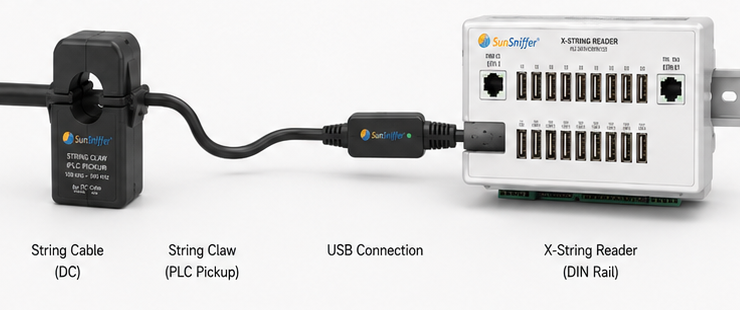
The String Claw clips around the string cable next to the inverter and plugs into the X-String Reader via USB. Clamp, plug, connect — done. No cable opened, no string disconnected, no downtime. One prerequisite: the clamp-on path suits layouts with one MPP tracker per string — there the inverter supplies the string current. Where several strings share one tracker, the X-String Reader adds its own string-current measurement (in development).
Start small. Prove the value.
The decision to add intelligence to an existing plant does not have to be all-or-nothing.